
Key Takeaways
- Outdoor kiosks help businesses reduce operational costs, improve customer engagement, and increase revenue opportunities.
- Advanced kiosk solutions enhance convenience, efficiency, and overall customer experience.
- Durable, customized kiosks from companies like I&E Automation are designed to withstand demanding outdoor environments.
- As technology continues to evolve, outdoor kiosks will play an increasingly important role in modern service delivery and business competitiveness.
In today’s dynamic business environment, companies are continually exploring innovative solutions to improve customer engagement and streamline operations. One such solution is the deployment of outdoor kiosks. These self-service stations offer numerous benefits, including cost reduction, enhanced customer satisfaction, and increased revenue opportunities. For businesses seeking tailored solutions, partnering with a custom outdoor kiosk manufacturer like I&E Automation Corporation can provide kiosks designed to withstand various environmental conditions and meet specific operational needs.
Cost-Effective Operations
Outdoor kiosks cut labor costs by replacing staffed points with self-service, saving 30–50% in parking facilities. They reduce overhead from training and supervision, enabling better staffing and a greater focus on strategic tasks. Kiosks need less maintenance and have modular parts for easy repairs, reducing expenses. Modern payment options such as contactless and mobile wallets further reduce cash-handling costs, boosting savings for businesses of all sizes.
Enhanced Customer Engagement
Outdoor kiosks offer 24/7 access, serving customers beyond business hours and appealing to early risers, night owls, and everyone in between. In public spaces, they act as interactive directories with real-time info and directions. Featuring multimedia and multilingual interfaces, they are accessible to tourists and users of all technical skill levels. Advanced models include video, live chat, and personalized suggestions, helping users find services quickly and creating memorable brand experiences that boost loyalty. They also gather feedback and data to improve user experience and services.
Increased Revenue Opportunities
Self-service kiosks have been shown to boost average transaction values through consistent upselling prompts. Studies indicate that digital ordering interfaces can increase order values by 15–30% by reliably prompting additional items, a task that human staff may perform inconsistently.
Outdoor kiosks also enable businesses to launch targeted marketing campaigns by utilizing customer data and AI-driven analytics. Through dynamic displays and interactive prompts, companies can advertise new products, recommend complementary items, or provide timely promotions based on the time of day or season. In sectors like foodservice, upselling is automated, leading to greater acceptance of extras such as drinks or sides. Revenue streams are further expanded by the ability to sell advertising space on kiosks, especially in high-traffic locations such as transport hubs or shopping centers. Kiosk analytics provide insights into purchasing behaviors, allowing businesses to refine product offerings and marketing strategies for maximum impact.
Improved Customer Experience
Deploying outdoor kiosks reduces wait times by spreading service across multiple access points, leading to faster service and higher satisfaction. In parks and campuses, kiosks act as directories with real-time info and directions. Touchscreens can be customized for accessibility, like larger text or audio prompts. Many now offer contactless payments for quick, secure transactions. Quick, independent access builds positive perceptions and brand loyalty. Customers value privacy and convenience, especially for sensitive services. Also, fewer crowds during peak hours create a calmer, more organized environment.
Durability and Weather Resistance
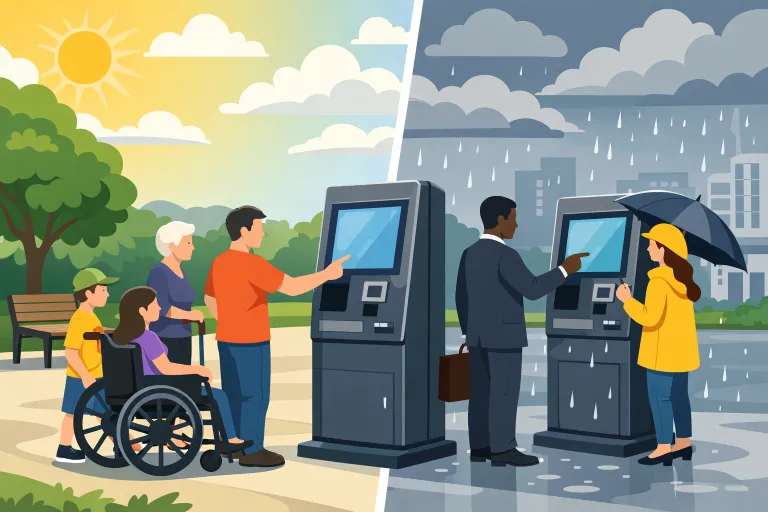
Modern outdoor kiosks are built to endure various environmental conditions, featuring weatherproof enclosures rated IP65 or higher, high-brightness displays for sunlight visibility, and thermal management for extreme climates. Constructed from durable materials like powder-coated steel, aluminum, and vandal-resistant glass, many include heating, cooling, surge protection, and industrial-grade hardware for reliability. Additional features like anti-glare coatings, sealed touchscreens, and tamper-proof locks safeguard against weather, dust, and vandalism. Regular maintenance and remote monitoring ensure long-lasting, dependable service in any location.
Versatility Across Industries
Outdoor kiosks are versatile tools used across sectors. In hospitality, they handle check-ins and concierge services. Retailers use them for curbside pickups and browsing, while transportation hubs employ them for ticketing and real-time updates. They are valuable for many business models. Healthcare uses them for patient check-in, info, and scheduling, streamlining processes. Municipalities utilize kiosks for bill payment, permits, and wayfinding, increasing accessibility. Entertainment venues deploy kiosks for tickets, merchandise, and guides. Educational institutions benefit by providing maps, updates, and alerts. Their adaptability is boosted by peripherals like barcode scanners, printers, cameras, and biometric readers to meet specific needs.
Technological Advancements
Recent innovations have advanced outdoor kiosk technology, boosting performance and durability. Features like brighter displays, better environmental resistance, and smarter software expand their use. Battery-powered kiosks provide sustainable, portable options for retail and hospitality. Cloud integration enables centralized management and real-time updates, ensuring reliability. AI and machine learning help kiosks adapt to users, predict needs, and automate support. Support for remote diagnostics and over-the-air updates cuts maintenance costs. Green tech, such as solar power and energy-efficient parts, reduces environmental impact and operating costs. Customizable software for branding and CRM improves value for organizations.
Conclusion
Integrating outdoor kiosks offers strategic advantages like reducing costs, boosting engagement, and increasing revenue. As technology evolves, these kiosks will become crucial for efficient customer experiences. Partnering with a custom manufacturer like I&E Automation ensures kiosks that withstand environmental conditions and serve specific needs. Outdoor kiosks are transforming service delivery and customer interaction. As competition grows, companies that adopt advanced kiosks stay ahead by offering convenience, savings, and loyalty. These kiosks evolve with technological and market changes, improving hardware and software. Successful deployments boost efficiency, revenue, and customer experience, making interactions quicker, smoother, and more engaging.


